
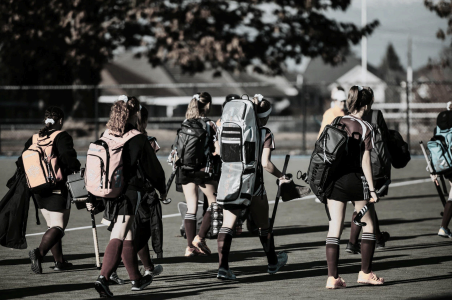
As a parent, you want to do the "right" thing. Recently, I found myself in a common debate at home regarding my daughter’s hockey practice. My instinct has been that she actually does better—more focused, more independent, more "in the zone"—when I’m not there. I prefer to drop her off, let her cope with the drills and the social dynamics on her own, and then show up for the games to support the competitive side she loves.
My wife, however, raised a fair point: shouldn’t we be watching the practices to provide a "safe environment"? Is our physical presence the security blanket they need to thrive?
It’s a classic parental tug-of-war between being there and giving space. However, from a psychological welfare perspective, "dropping and going" isn’t just a convenience—it might be one of the best developmental gifts you can give a young athlete.
1. The "Observer Effect" and the Glance Back
In sports psychology, the Observer Effect is real. When a seven-year-old knows a parent is watching, the practice session changes from a "learning lab" to a "performance."
Practice is supposed to be messy. It’s where kids should feel free to fall over, miss the ball, and make mistakes without looking toward the sidelines to gauge a parent’s reaction.
If your child is more engaged when you aren't there, it’s often because they’ve moved from seeking external validation to finding internal drive. They aren't "Paul’s daughter" in that moment; they are just a hockey player.
2. Autonomy: The "Social Lab" of Sport
Sports practices are as much about social hierarchy and peer bonding as they are about skills. When we "drop and go," we allow our children to navigate social friction and coach instructions entirely on their own.
This builds self-efficacy—the internal belief that "I can handle this." By giving them that hour of independence, we are providing a "psychologically safe" space where they are the protagonists of their own story, not just a character in ours.
3. Active Modeling vs. Passive Spectating
There is a strange phenomenon in youth sports today: the "spectator culture." You’ll often see sidelines full of parents who are sedentary, perhaps even overweight or disconnected, watching their kids "try their best."
There is a massive psychological gap here. Children are highly tuned to Social Modeling. They notice when a parent values their own physical "engine" versus when a parent is merely a passive consumer of the child’s effort.
If you maintain your own fitness and lead an active lifestyle, you are providing a more powerful form of "support" than a parent sitting on a folding chair for sixty minutes. You are showing them that physical competence is a lifelong standard, not a childhood phase.
4. Redefining "Safety"
My wife is right that a safe environment is vital, but for a child who thrives in competition, "safety" is often found in the consistency of the return. Psychological safety for a young athlete is knowing that regardless of how the practice went, the person picking them up is a "consistent base"—someone who is interested in whether they had fun, rather than a technical critique of their footwork.
The Verdict
If your child is happy, competing hard, and growing in your absence, it isn’t a sign that you’re "missing out." It’s a sign that you’ve raised a child secure enough to venture out into the world without needing to look back over her shoulder.
The best support we can give sometimes isn't our eyes on the field—it’s the active example we set in our own lives and the space we give them to own their own game.
By Paul White, Running + Hockey Physio + Dad







Recent Comments